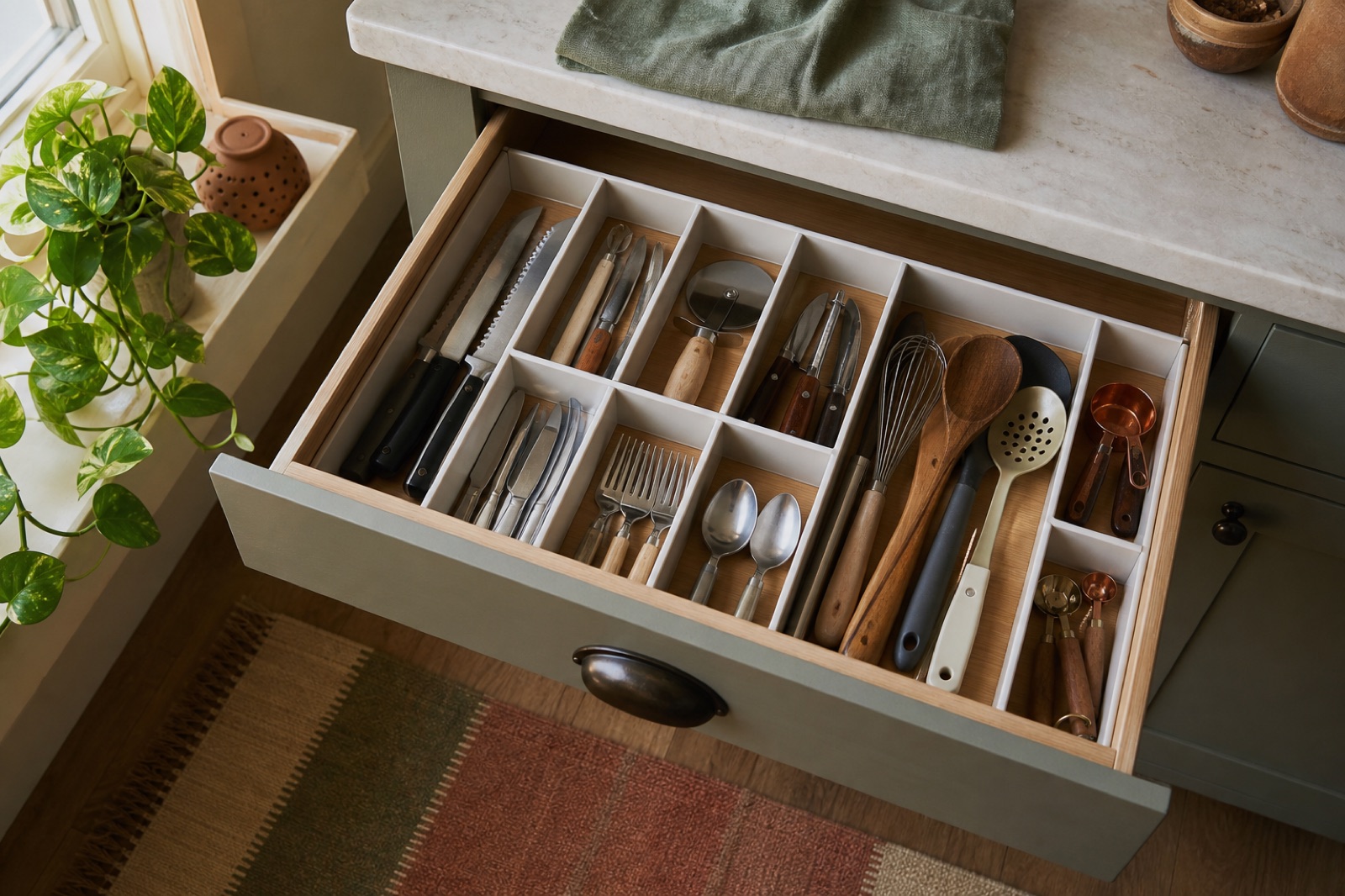
Drawer dividers work when they create a small number of useful lanes. They fail when every object gets a narrow compartment and the system cannot adapt to a new utensil or changing routine.
Research boundary
What this guide is—and is not.
This guide compares storage approaches using space planning, access, load, and installation constraints. It does not claim hands-on testing of a specific retail product. Any future product recommendation must satisfy the measurements and limitations stated below.
How our guides are prepared →A practical plan
Start with the space you have.
- 1
Empty the drawer and group contents by task, not by exact shape.
- 2
Measure internal width, depth, and usable height below the drawer above.
- 3
Create the fewest sections that keep groups from crossing.
- 4
Test the layout with temporary cardboard strips before buying a system.
Options worth comparing
Choose the product type after you measure.
These are product types to evaluate—not claims that one item will fit every home. Selected links open a current Amazon search so you can compare dimensions, installation details, availability, and recent customer feedback yourself.
As an Amazon Associate I earn from qualifying purchases.
VaeFae 6-pack adjustable bamboo drawer dividers
- Best for
- Long lanes for utensils or folded clothing in medium-to-large drawers
- Check first
- The selected set expands from 16.6 to 21.8 inches and is 2.4 inches high; measure the drawer's clear interior, not the cabinet face
- Limitation
- It will not fit shorter drawers, and spring pressure can bow thin drawer walls or shift on very slick surfaces
Modular tray set
- Best for
- Small items that change over time
- Check first
- Add the outside dimensions of the exact tray arrangement
- Limitation
- Small gaps between trays collect crumbs and waste space
Cut-to-fit grid
- Best for
- Custom compartments in deep drawers
- Check first
- Verify material can be cut cleanly and stays locked together
- Limitation
- Time-consuming to adjust and can feel flimsy under heavy tools
Non-slip drawer liner
- Best for
- Wide categories that only need movement control
- Check first
- Choose washable, non-adhesive material safe for the drawer finish
- Limitation
- Does not prevent categories from mixing during frequent use
Easy mistakes
What to avoid
- Measuring only the drawer front instead of the internal box
- Creating a separate compartment for rarely used duplicates
- Using adhesive products before checking the cabinet finish
Quick answers
Questions to settle before checkout
How many sections should a drawer have?
Use the fewest sections that keep categories distinct. Many kitchen drawers work well with three to five lanes.
What if the dividers slide?
Check tension, contact pads, and whether the liner underneath is reducing grip. Do not over-tighten against thin walls.
Should everything lie flat?
Only if drawer height and item shape allow it. Deep drawers may work better with upright or angled storage designed for that purpose.
Editorial status
As an Amazon Associate I earn from qualifying purchases.
Full disclosure policy →