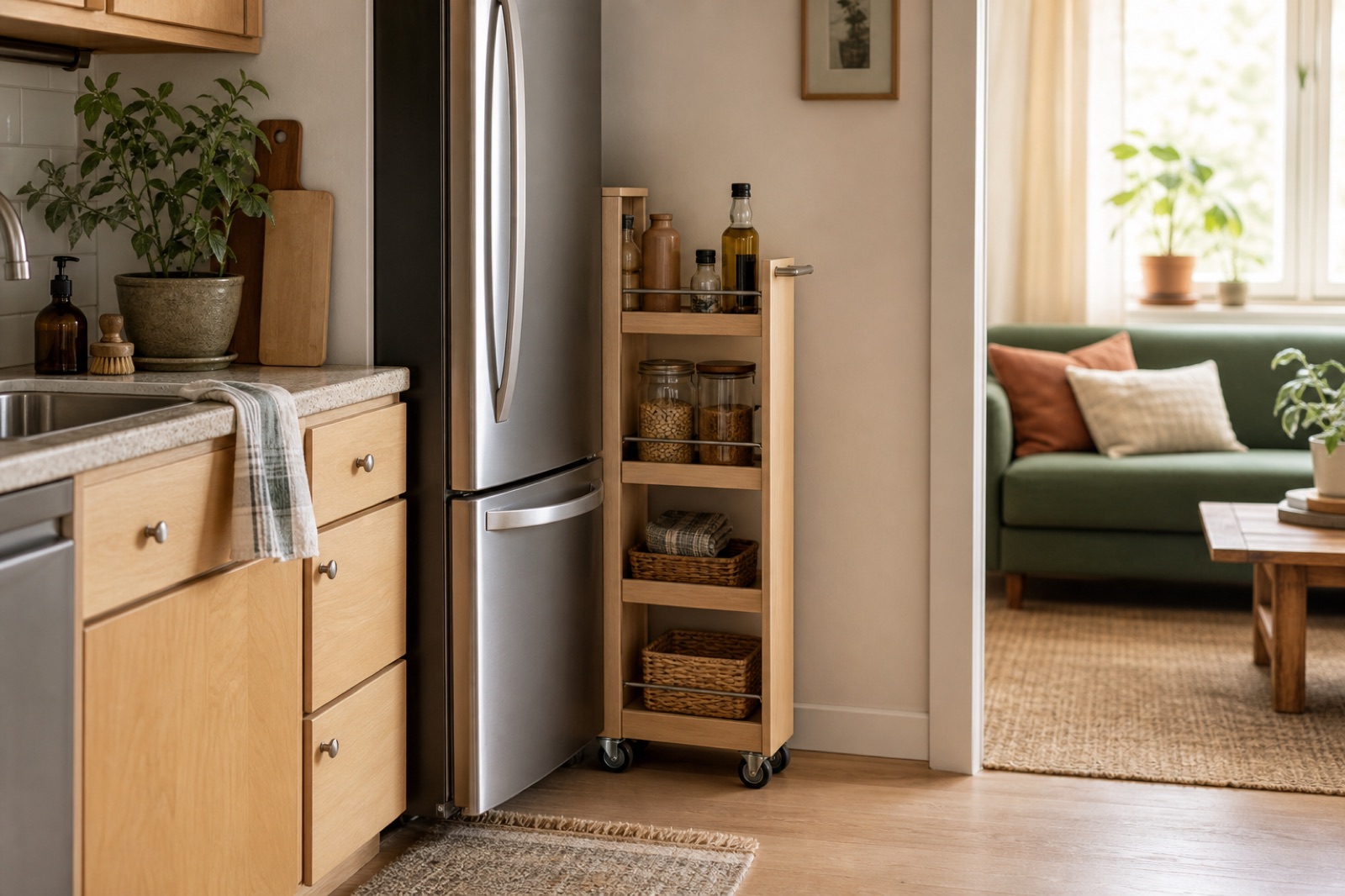
The advertised width of a slim cart rarely tells the whole story. Wheels, handles, baseboards, and the room needed to pull it out can turn a promising gap into unusable storage.
Research boundary
What this guide is—and is not.
This guide compares storage approaches using space planning, access, load, and installation constraints. It does not claim hands-on testing of a specific retail product. Any future product recommendation must satisfy the measurements and limitations stated below.
How our guides are prepared →A practical plan
Start with the space you have.
- 1
Measure the gap at the floor, middle, and top; walls and appliances are not always parallel.
- 2
Subtract at least half an inch for easy movement and minor measurement error.
- 3
Map the direction the cart must roll and the clear space needed to access lower shelves.
- 4
Choose contents by weight and frequency before choosing shelf count.
Options worth comparing
Choose the product type after you measure.
These are product types to evaluate—not claims that one item will fit every home. Selected links open a current Amazon search so you can compare dimensions, installation details, availability, and recent customer feedback yourself.
As an Amazon Associate I earn from qualifying purchases.
Pipishell 3-tier slim bathroom storage cart (7.1-inch)
- Best for
- Frequently used lightweight bathroom, pantry, or laundry supplies
- Check first
- Verify the 7.1-inch narrow side, 15.8-inch length, 26.4-inch height, wheel path, and room to pull the cart out
- Limitation
- The open plastic shelves expose clutter, and this is not the best choice for dense or top-heavy loads
Pull-out gap tower
- Best for
- Very narrow gaps with straight front access
- Check first
- Confirm the unit is stable at full extension
- Limitation
- Tall narrow towers can tip if heavy items are stored high
Locking utility cart
- Best for
- A cart that also serves as a movable work surface
- Check first
- Check total width with bumpers and the wheel-lock location
- Limitation
- Locking casters add bulk and still need level flooring
Fixed narrow shelf
- Best for
- Gaps where rolling access adds no practical benefit
- Check first
- Check wall anchoring requirements and appliance ventilation
- Limitation
- Harder to clean behind and not suitable beside heat-producing appliances
Easy mistakes
What to avoid
- Using a cart to fill required ventilation space beside an appliance
- Loading glass bottles high on a narrow mobile unit
- Assuming a cart can turn after it clears the gap
Quick answers
Questions to settle before checkout
How much clearance should I allow?
Half an inch beyond the cart's widest assembled point is a practical minimum. Uneven floors or angled walls may require more.
Are more tiers always better?
No. Extra tiers reduce vertical clearance and can make lower items hard to see. Match shelf count to what you will store.
Can a cart sit next to a refrigerator?
Only if the appliance manual allows that clearance and the cart does not block ventilation, doors, or maintenance access.
Editorial status
As an Amazon Associate I earn from qualifying purchases.
Full disclosure policy →